Tranexamic Acid in Rhinoplasty: Improving Precision and Faster Recovery
Discover how tranexamic acid (TXA) reduces bruising and swelling in rhinoplasty, improves surgical precision, and speeds recovery. Evidence-based guide.
Written and medically reviewed by Ufuk Askeroglu, MD — Plastic, Reconstructive and Aesthetic Surgeon. Last reviewed: November 2026.
Tranexamic Acid in Rhinoplasty: Less Bruising, Faster Recovery
Swelling and bruising are two of the concerns patients mention most often before nose surgery, and for good reason — they shape how quickly someone feels ready to return to work and social life. In recent years, tranexamic acid (TXA) has moved from the operating rooms of general surgery into facial plastic surgery as a practical way to improve both the surgery itself and the days that follow it.
A recent systematic review and meta-analysis looked specifically at TXA in rhinoplasty, and the results were encouraging. Patients who received the medication tended to bleed less during surgery, which gave their surgeons a cleaner view of the delicate structures being reshaped. They also reported less bruising afterwards, milder swelling, and in many cases an earlier return to everyday activities.
How tranexamic acid actually works
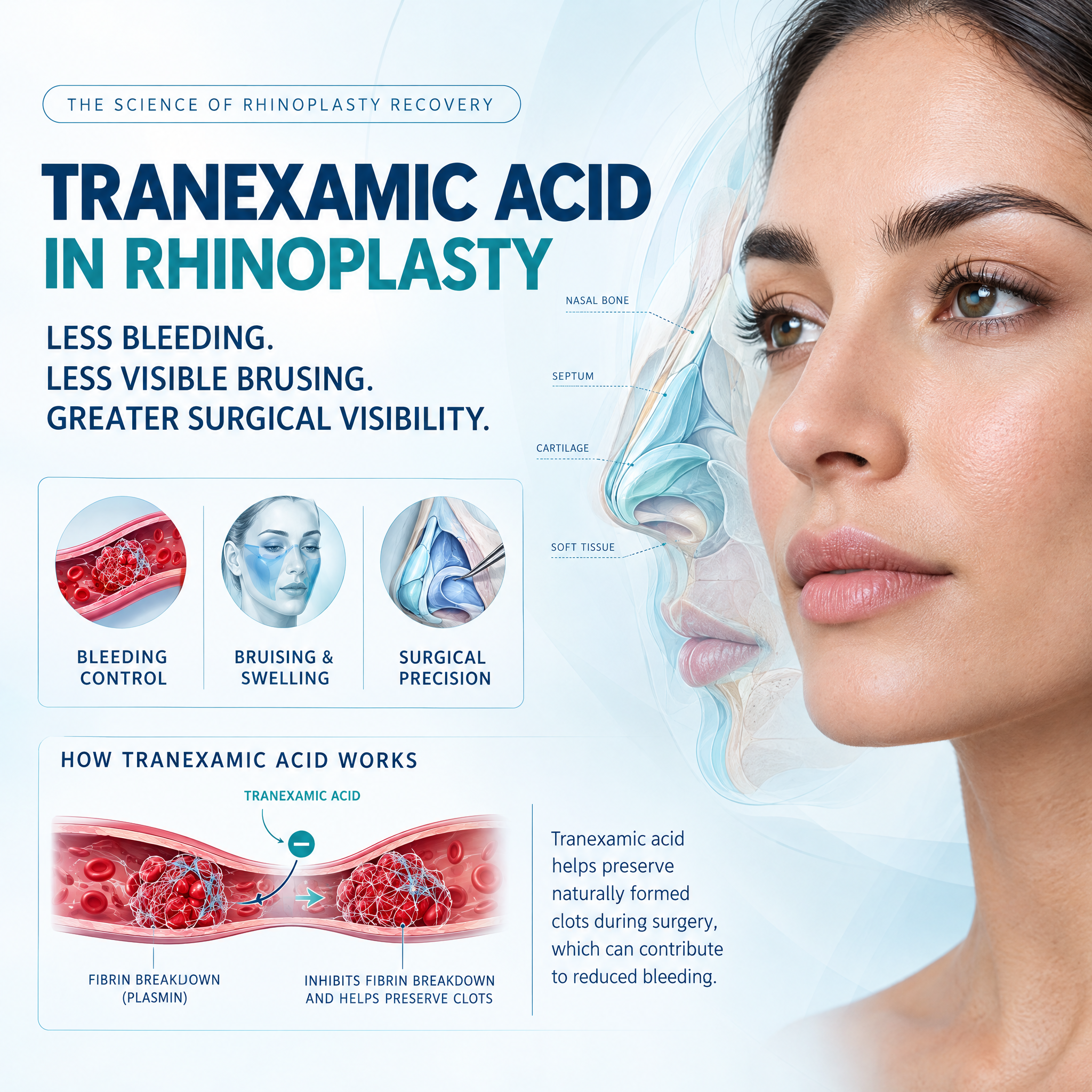
TXA is an antifibrinolytic agent. In plain terms, it helps the body hold onto the small blood clots that naturally form during surgery instead of breaking them down too quickly. During a rhinoplasty, this translates into reduced microscopic oozing as the surgeon lifts and dissects tissue. The payoff is a drier, clearer surgical field — and in nose surgery, visibility is everything.
When a surgeon can see the anatomy clearly, finer work becomes possible during tip suturing, cartilage refinement, preservation dissection, and structural graft placement. These steps happen at a millimetre scale, so even a small improvement in visibility can nudge the final result toward greater accuracy and symmetry.
Why reduced bruising matters to patients
The same review reported lower post-operative bruising (ecchymosis) scores across most treatment groups. For the person recovering, this is not a cosmetic footnote — it is often the difference between hiding away for two weeks and feeling comfortable in public much sooner. Less visible bruising generally means greater day-to-day comfort, lower anxiety during healing, and confidence returning earlier. For patients travelling to Turkey for rhinoplasty, where recovery time before flying home may be limited, this can be particularly valuable.
Is it safe?
Safety is naturally the first question. Reassuringly, researchers found no meaningful increase in serious clotting complications when TXA was used appropriately in healthy, carefully screened patients. That finding supports its growing place within “enhanced recovery” protocols — structured plans designed to make surgery smoother and healing quicker.
It is worth being clear about what TXA is not. It is not a shortcut, and it does not replace meticulous surgical technique. A beautiful, functional nose is still built on anatomical knowledge, careful planning, and experienced hands. What TXA does is improve the biological environment in which that precise work takes place. Think of it as optimising the conditions rather than performing the surgery.
Modern rhinoplasty increasingly concerns itself with more than the final shape. Patients rightly want beautiful outcomes, safer surgery, shorter downtime, and less visible bruising all at once. TXA helps move all four goals in the right direction, which is why it is becoming a standard consideration in advanced practices. As the field evolves, medications that gently improve healing conditions are likely to become routine — and TXA is among the most practical advances available today. Its real value is simple: it helps already excellent surgery become a little better.
Frequently Asked Questions
Does tranexamic acid reduce swelling after rhinoplasty?
Evidence suggests yes. Patients receiving TXA often experience reduced swelling intensity and less bruising, which can shorten the visible recovery period and help you feel socially comfortable sooner.
Is tranexamic acid safe for nose surgery?
In healthy, properly screened patients, studies have not shown a meaningful increase in serious clotting complications when TXA is used appropriately. Your surgeon will review your medical history before deciding if it is suitable.
How is TXA given during rhinoplasty?
It is typically administered intravenously around the time of surgery, though protocols vary between clinics. Your surgical team will choose the approach and dosing based on your case.
Will TXA improve my final nose shape?
Not directly. TXA improves surgical visibility and reduces bleeding, which can support more precise work, but the aesthetic result depends on your surgeon’s technique and your anatomy.
Who should avoid tranexamic acid?
Patients with a history of clotting disorders, certain cardiovascular conditions, or specific medication interactions may not be candidates. A thorough pre-operative assessment is essential.
Clinical References
PubMed / NCBI
1. Awaji H, et al. Efficacy of Dexamethasone and Tranexamic Acid in Reducing Bleeding, Edema, and Ecchymosis in Rhinoplasty Patients: A Systematic Review and Meta-Analysis. Cureus. 2025 Nov;17(11):e96698. PMCID: PMC12700630. PMID: 41393694.
🔗 https://pmc.ncbi.nlm.nih.gov/articles/PMC12700630/
2. Tranexamic Acid in Patients Undergoing Rhinoplasty: An Updated Systematic Review and Meta-Analysis of Randomized Controlled Trials. Aesthet Plast Surg. 2024 Jun;48(11):2076-2085. PMID: 38097691.
🔗 https://pubmed.ncbi.nlm.nih.gov/38097691/
3. Di Martino L, Mokhtar J, Akbarpoor F, Kreutz-Rodrigues L, Vyas K, Cetrulo CL, Lellouch AG. Local Tranexamic Acid vs Placebo in Patients Undergoing Septorhinoplasty: A Systematic Review and Meta-analysis of Randomized Controlled Trials. Aesthet Surg J. 2025 Nov;45(12):1220-1226. PMID: 40972659.
🔗 https://pubmed.ncbi.nlm.nih.gov/40972659/
4. Tranexamic Acid Application in Facial Aesthetic Surgery: An Umbrella Review (14 systematic reviews and meta-analyses). Aesthet Surg J Open Forum. 2024 Nov. PMCID: PMC11630850. DOI: 10.1093/asjof/ojae105.
🔗 https://pmc.ncbi.nlm.nih.gov/articles/PMC11630850/
5. Longino ES, et al. Intravenous Tranexamic Acid in Rhinoplasty: A Randomized Controlled Trial. Facial Plast Surg Aesthet Med. 2025. PMID: 40042121.
🔗 https://pubmed.ncbi.nlm.nih.gov/40042121/
6. Khajuria A, Rohrich RJ, et al. Tranexamic Acid in Rhinoplasty and Septoplasty: A Systematic Review and Meta-analysis of Randomized Controlled Trials. Plast Reconstr Surg Glob Open. 2024 Nov;12(11):e6275.
🔗 https://pubmed.ncbi.nlm.nih.gov/
7. De Vasconcellos SJDA, Do Nascimento-Júnior EM, et al. The Impact of Local Tranexamic Acid Infiltration on Periorbital Ecchymosis and Edema in Rhinoplasty: A Triple-Blinded Randomized Controlled Trial. Aesthet Surg J Open Forum. 2025;8:ojaf172. PMID: 41623428.
🔗 https://pubmed.ncbi.nlm.nih.gov/41623428/
