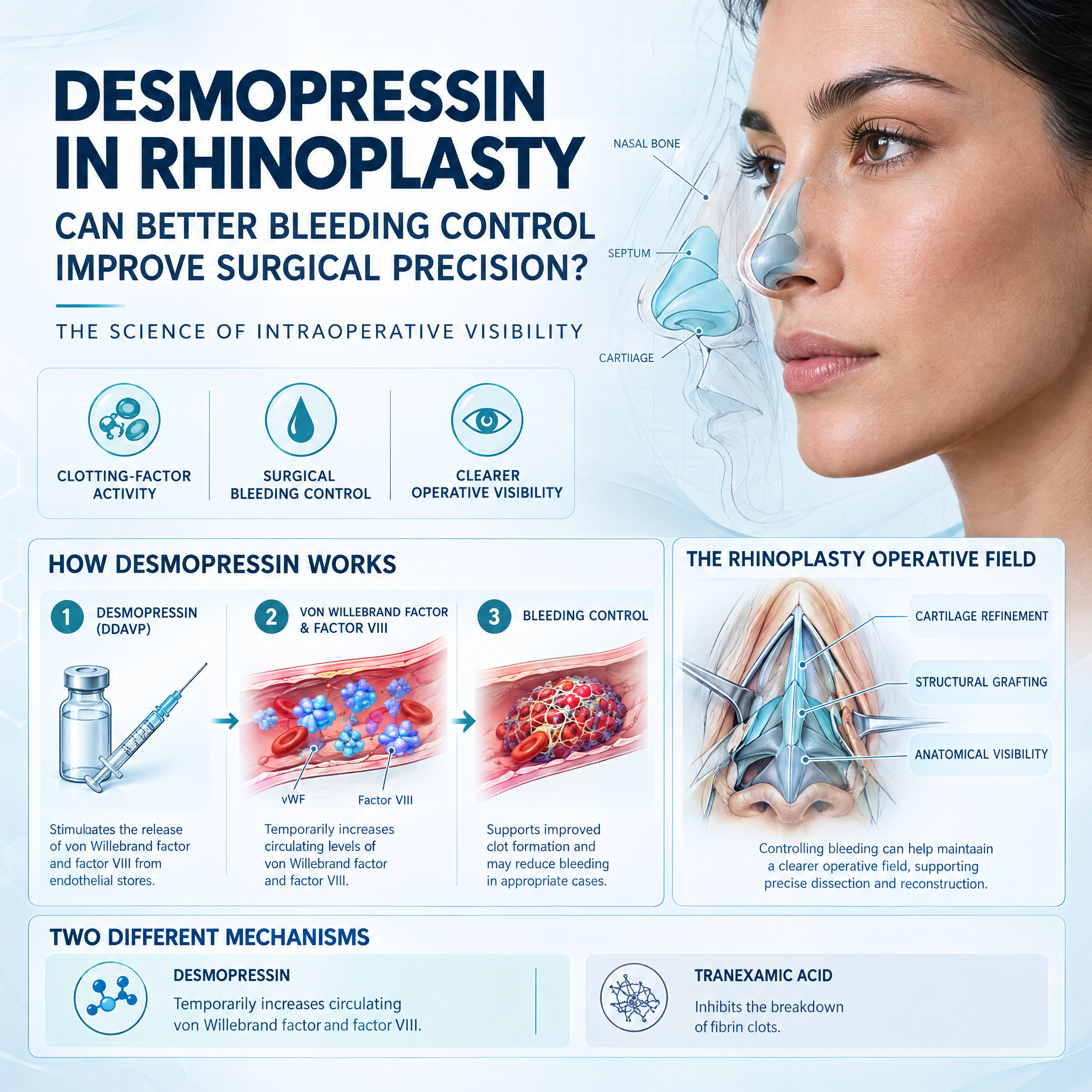
Desmopressin in Rhinoplasty: Can Better Blood Control Improve Surgical Precision?
Learn how preoperative desmopressin may reduce bleeding and improve surgical visibility in complex rhinoplasty, and which patients benefit most.

Written and medically reviewed by Ufuk Askeroglu, MD — Plastic, Reconstructive and Aesthetic Surgeon. Last reviewed: November 2026.
What is Desmopressin in Rhinoplasty?
Rhinoplasty is one of the most delicate operations in all of facial plastic surgery. The structures being reshaped are small, the margins for error are measured in millimetres, and even minor bleeding can cloud the surgeon’s view at the exact moment precision matters most. This becomes especially relevant during technically demanding steps such as cartilage preservation, structural graft placement, tip reshaping, and the correction of asymmetry.
A 2025 systematic review explored whether giving desmopressin before surgery could improve these conditions by reducing bleeding during the operation. The results suggest that, in carefully chosen cases, it may offer real benefits.
The mechanism in simple terms
Desmopressin works by raising the body’s levels of von Willebrand factor and factor VIII — two proteins central to effective blood clotting. By temporarily boosting the body’s own ability to control minor bleeding, it helps the surgeon work in a cleaner, clearer field. According to the review, patients who received desmopressin before surgery frequently experienced lower blood loss during the operation, improved visibility, shorter operative times in selected procedures, reduced bruising afterwards in some cases, and greater precision during cartilage refinement.
Why a clearer field changes outcomes
It is easy to underestimate how much visibility shapes a rhinoplasty result. Even subtle bleeding can obscure cartilage edges and important structural landmarks. When the view is compromised, every delicate manoeuvre becomes harder. A cleaner operative field lets the surgeon perform finer suturing, assess symmetry more accurately, refine contour transitions with greater control, and avoid unnecessary tissue handling. These may sound like small gains, but in rhinoplasty, small details accumulate into major differences in the long-term outcome.
Not for everyone
Importantly, the review was clear that desmopressin should not be treated as a routine requirement for every patient. Its benefits appear strongest in specific situations: complex structural reconstruction, revision rhinoplasty, patients with mild clotting inefficiencies, and long procedures where precision must be sustained for hours. By contrast, healthy, low-risk patients undergoing straightforward cosmetic refinement may not need pharmacologic bleeding control at all.
This reflects a broader shift in how modern rhinoplasty is practised. Rather than applying the same protocol to everyone, surgeons increasingly individualise their perioperative strategy based on anatomy, procedure complexity, and each patient’s physiology. Desmopressin is one expression of that trend — a tool reserved for the cases most likely to benefit.
As with every pharmacologic aid, perspective matters. Desmopressin is not a substitute for meticulous technique. It cannot replace careful dissection, precise control of bleeding points, or years of surgical experience. What it can do is enhance the biological environment in which expert surgery is performed. As rhinoplasty continues to push toward higher precision and faster recovery, medications like desmopressin may become valuable additions to select advanced protocols. The future of surgical excellence lies not only in technical skill, but in optimising every condition that supports it.
Frequently Asked Questions
What does desmopressin do during rhinoplasty?
It temporarily increases clotting factors in the blood, which can reduce bleeding during surgery and give the surgeon a clearer field for precise work.
Who is a good candidate for desmopressin in nose surgery?
It is most useful in complex reconstruction, revision cases, long procedures, and patients with mild clotting inefficiencies — not routine, straightforward cosmetic refinements.
Does desmopressin have side effects?
Possible effects include fluid retention and changes in sodium levels, so it is used selectively and under careful medical supervision. Your surgeon will assess your suitability.
Is desmopressin the same as tranexamic acid?
No. Both reduce bleeding but through different mechanisms — desmopressin boosts clotting factors, while tranexamic acid prevents clots from breaking down too early.
Will desmopressin improve my cosmetic result?
Indirectly, by improving surgical visibility and precision. The aesthetic outcome still depends primarily on your surgeon’s skill and your anatomy.
Clinical References
PubMed / NCBI
1. Preoperative Desmopressin for Bleeding Reduction During Rhinoplasty: A Systematic Review and Meta-Analysis of Randomized Controlled Trials. Aesthet Plast Surg. 2025 Nov;49(21):5978-5987. PMID: 40456991. DOI: 10.1007/s00266-025-04916-7.
🔗 https://pubmed.ncbi.nlm.nih.gov/40456991/
2. Kim SH, Bae AY, Kim DH, Hwang SH. Does Desmopressin Reduce Intraoperative Bleeding in Patients Who Undergo Nasal Surgery? A Systematic Review and Meta-Analysis. J Rhinol. 2024 Mar;31(1):8-16. PMCID: PMC11566543. PMID: 39664036.
🔗 https://pmc.ncbi.nlm.nih.gov/articles/PMC11566543/
3. Zamani MR, Imani B, Abbasi R, Karimi A, Moslehi S. Effectiveness of Bleeding Control Methods in Rhinoplasty: A Systematic Review and Meta-Analysis. Arch Plast Surg. 2026 Jan. PMCID: PMC12858317. DOI: 10.1055/a-2706-1208.
🔗 https://pmc.ncbi.nlm.nih.gov/articles/PMC12858317/
4. Akbarpour M, Jalali MM, Akbari M, Nasirmohtaram S, Haddadi S, Faghih Habibi A, Azad F. Investigation of the Effects of Intranasal Desmopressin on Bleeding During Open Septorhinoplasty: A Randomized Double-Blind Clinical Trial. Heliyon. 2023;9(7):e17855. PMCID: PMC10344754. PMID: 37455992.
🔗 https://pmc.ncbi.nlm.nih.gov/articles/PMC10344754/
5. Haddady-Abianeh S, Rahmati J, Delavari C, Molaei H. Comparison of the Effect of Injectable Tranexamic Acid and Inhaled Desmopressin in Controlling Bleeding and Ecchymosis in Open Rhinoplasty. World J Plast Surg. 2022;11(3):24-27. PMID: 36694687.
🔗 https://pubmed.ncbi.nlm.nih.gov/36694687/
6. Haddady-Abianeh S, Rajabpour AA, Sanatkarfar M, Farahvash MR, Khorasani G, Molaei H. The Hemostatic Effect of Desmopressin on Bleeding as a Nasal Spray in Open Septorhinoplasty. Aesthet Plast Surg. 2019;43(6):1603-1606. PMID: 31451854.
🔗 https://pubmed.ncbi.nlm.nih.gov/31451854/
7. Barinsky GL, Buziashvili D, Svider PF, Carron MA, Folbe AJ, Hsueh WD, Eloy JA, Johnson AP. Perioperative Desmopressin for Patients Undergoing Otolaryngologic Procedures: A Systematic Review. Otolaryngol Head Neck Surg. 2019 Jul;161(1):36-45. PMID: 30857487.
🔗 https://pubmed.ncbi.nlm.nih.gov/30857487/
