Deviated Septum and Septoplasty in Turkey: Breathe and Look Better
Septoplasty in Turkey corrects a deviated septum to improve breathing, and can be combined with rhinoplasty. Who needs it, cost, recovery and what to expect.
Written and medically reviewed by Ufuk Askeroglu, MD — Plastic, Reconstructive and Aesthetic Surgeon. Last reviewed: November 2026.
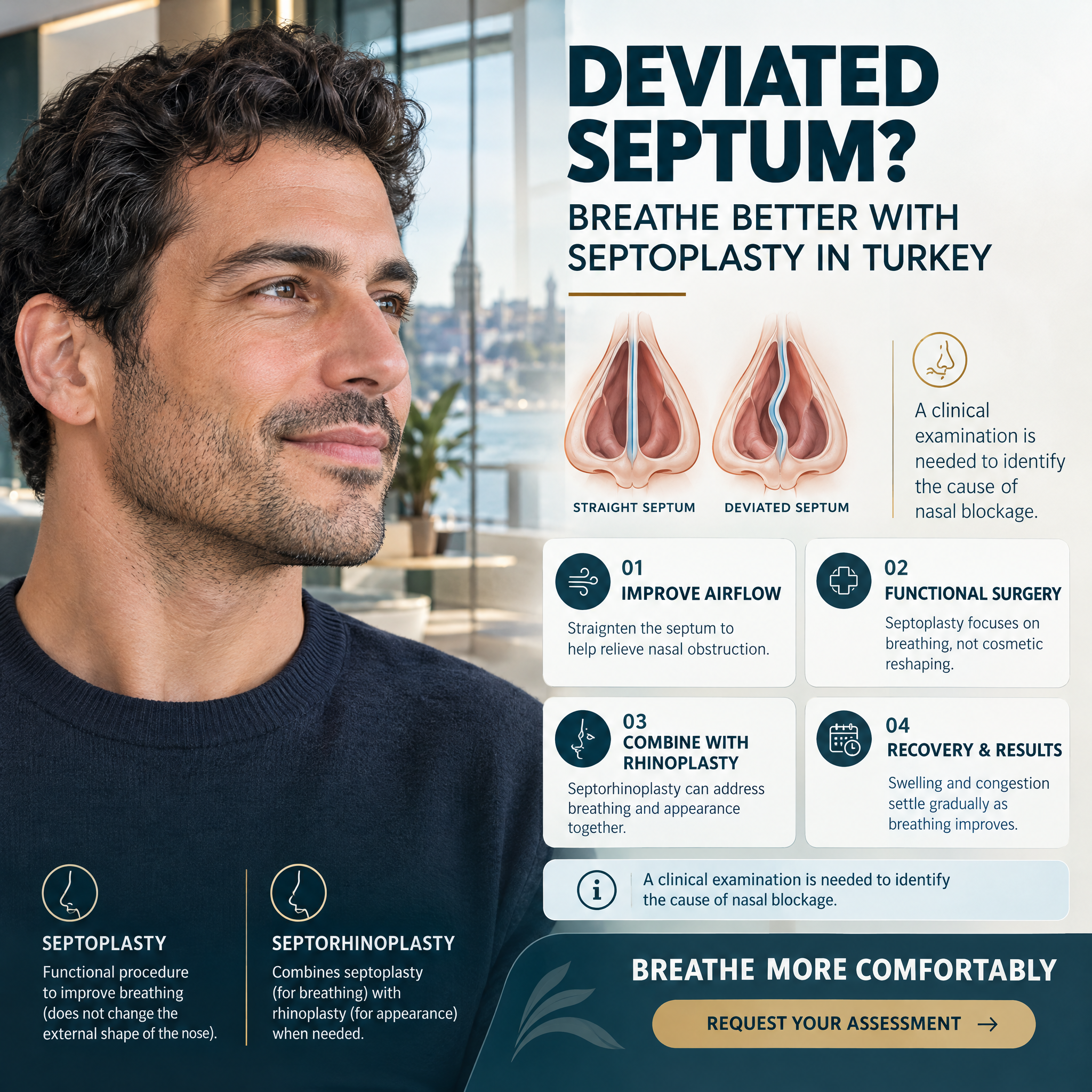
A deviated septum is when the wall between your nostrils is off-centre, which can block breathing on one or both sides. Septoplasty in Turkey is the operation that straightens it to improve airflow. It is primarily a functional (breathing) procedure, but it is often combined with cosmetic rhinoplasty — called septorhinoplasty — so you can improve both breathing and appearance in one operation. An examination confirms whether your septum is the cause of your symptoms.
Signs of a deviated septum
Common symptoms include persistent blockage on one side, difficulty breathing through the nose, recurrent congestion or sinus issues, and sometimes snoring or disturbed sleep. Only an examination can confirm the septum is the cause, as other issues can produce similar symptoms.
Septoplasty in Turkey: Procedure, Options and Recovery
Septoplasty vs septorhinoplasty
Septoplasty straightens the septum to improve breathing and does not change the external shape. Septorhinoplasty combines that functional correction with cosmetic reshaping of the nose, so if you want to breathe better and change how your nose looks, it can be done together — often more efficient than two separate operations.
Septoplasty in Turkey: cost and recovery
When combined with rhinoplasty, pricing is part of the overall package [confirm current pricing]; functional-only septoplasty may be quoted differently. Recovery is broadly similar to rhinoplasty: some congestion as internal swelling settles, a return to desk work in one to two weeks, and improving breathing over the following weeks.
Why it matters to get this assessed
If you are considering cosmetic rhinoplasty and also have breathing trouble, raise it early — a good surgeon assesses the airway as well as the appearance, so a functional problem is corrected rather than missed.
Next step: Share your goals and photos for a free, no-obligation assessment tailored to your nose type. [Link to consultation form / WhatsApp]
Frequently Asked Questions
What is septoplasty?
Surgery to straighten a deviated (off-centre) septum and improve breathing. It corrects function and does not, on its own, change the external shape of the nose.
Can I combine septoplasty with a nose job?
Yes. Septorhinoplasty combines functional septum correction with cosmetic reshaping in one operation, improving both breathing and appearance together.
Will septoplasty change how my nose looks?
Septoplasty alone is functional and doesn’t change the external shape. If you also want a cosmetic change, that is septorhinoplasty, done at the same time.
How do I know if I have a deviated septum?
Symptoms like one-sided blockage, difficulty breathing through the nose and recurrent congestion can suggest it, but only an examination can confirm the cause.
How much does septoplasty cost in Turkey?
When combined with rhinoplasty it is part of the overall package [confirm current pricing in 2026]; a functional-only procedure may be quoted separately. Get the details in writing.
Clinical References
PubMed / NCBI
1. Septoplasty Versus Non-Surgical Treatment for Deviated Nasal Septum: A Systematic Review and Meta-Analysis (septoplasty provides greater improvement in symptoms and quality of life than non-surgical approaches; NOSE and SNOT-22 scores compared). J Clin Med. 2026 May;15(10):3930. PMID: 42194891.
🔗 https://pubmed.ncbi.nlm.nih.gov/42194891/
2. Alanzi O, Assiri H, Aldosari B, Alarfaj A. Evaluating Change in Quality of Life as Long-Term Outcome Measure Post Septorhinoplasty: A Systematic Review (septorhinoplasty significantly enhances QoL; nasal obstruction improvement correlates strongly with overall QoL). Indian J Otolaryngol Head Neck Surg. 2025 Aug;77(8):3348-3369. PMCID: PMC12297172. PMID: 40727204.
🔗 https://pubmed.ncbi.nlm.nih.gov/40727204/
3. Endoscopic Septoplasty: A Narrative Review of Outcomes, Complications and Patient-Reported Score (both conventional and endoscopic septoplasty effective; endoscopic associated with superior visualization and lower complication rates). J Clin Med. 2026 Jan;62(1):135. PMID: 41597421.
🔗 https://pubmed.ncbi.nlm.nih.gov/41597421/
4. Ingale M, et al. Improvement in Pulmonary Function Tests After Septoplasty: A Longitudinal Study (significant improvements in FEV1, FVC, exercise capacity and SNOT-22 scores; high patient satisfaction and minimal complications). Cureus. 2024 Jul;16(7):e65492. PMID: 39188501.
🔗 https://pubmed.ncbi.nlm.nih.gov/39188501/
5. Alanazy S, et al. Quality of Life and Symptoms Before and After Nasal Septoplasty With or Without Turbinoplasty (200 subjects; mean NOSE scores improved from 58.4 to 15.0 at 3 months; p<0.001). J Craniofac Surg. 2023 May;34(3):922-925. PMCID: PMC10128898. PMID: 36730854.
🔗 https://pubmed.ncbi.nlm.nih.gov/36730854/
6. Evaluation of Nasal Conditions on Sleep: Integrating Wearable Tech in Surgical Outcomes (deviated septum and turbinate hypertrophy significantly impacted sleep patterns, respiratory function and well-being; surgical correction provided significant relief). PMCID: PMC11169176. PMID: 38883547.
🔗 https://pubmed.ncbi.nlm.nih.gov/38883547/
7. Alkholaiwi F. Quality of Life of Patients With Nasal Obstruction Who Underwent Septoplasty: Assessed With the Glasgow Benefit Inventory (positive QoL change confirmed with validated instrument; nasal endoscopy and examination prior to septoplasty). Cureus. 2023 Sep;15(9):e45523. PMID: 37868415.
🔗 https://pubmed.ncbi.nlm.nih.gov/37868415/
