Frozen Cadaveric Rib Grafts in Revision Rhinoplasty: A New Standard?
Revision rhinoplasty is among the most demanding procedures in facial plastic surgery, because it usually requires rebuilding structural support that a previous operation weakened or removed. The central question for every revision case is simple: where does the cartilage come from?
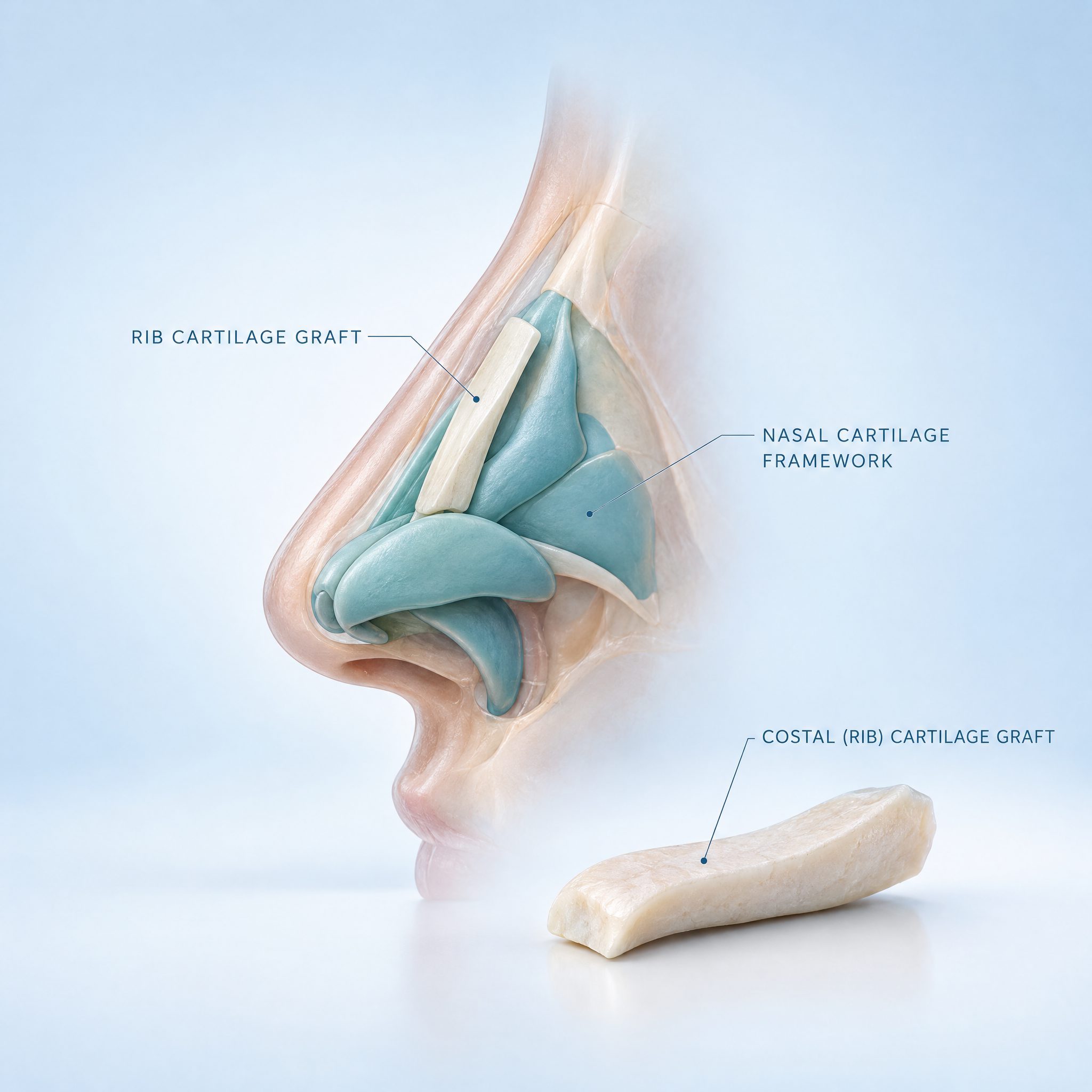
For decades, the answer was the patient’s own rib Revision Rhinoplasty Rib Graft). But a growing body of evidence — including a 2026 systematic review — suggests that frozen cadaveric rib grafts now deliver comparable results without the second surgical site. Here’s what that shift means for patients and surgeons.
What is a frozen cadaveric rib graft?
A frozen cadaveric rib graft (also called a fresh-frozen costal cartilage allograft or cadaveric rib cartilage) is donor rib cartilage that has been screened, processed, and preserved under strict tissue-bank standards. Unlike older irradiated homologous grafts, fresh-frozen allografts are processed from screened donors without the high-dose radiation that increased resorption in earlier graft types. It arrives “off the shelf,” ready to carve — no chest incision required.
Cadaveric Rib Graft Usage in Revision Rhinoplasty
Why autologous rib was the gold standard
Harvesting the patient’s own rib (autologous costal cartilage) has long been considered the reference standard because it provides:
- Strong structural support for the nasal framework
- Excellent long-term durability
- Large graft volume for major reconstruction
- Biological compatibility, since it’s the patient’s own tissue
The trade-off is real, though. Harvesting costal cartilage carries donor-site morbidity — (Revision Rhinoplasty Rib Graft) the risk of pneumothorax, postoperative pain, and hypertrophic scarring, along with increased operative time. For a patient already facing a complex revision, that’s a second wound to heal.
What the 2026 systematic review found
The 2026 review examined whether frozen cadaveric rib grafts are a reliable alternative — and the findings were encouraging. The meta-analysis concluded that frozen cadaveric costal cartilage can be used for rhinoplasty with low complication rates, with no donor-site morbidity and lower resorption than irradiated homologous cartilage.
When processed correctly, frozen rib grafts demonstrated:
- Low infection rates
- Minimal resorption
- Excellent contour stability
- Reliable structural integrity
Broader comparative data reinforce this. In one pooled analysis of 888 patients, there was no statistically significant difference between autologous and cadaveric grafts in warping, resorption, contour irregularity, infection, or revision surgery. In other words: comparable outcomes, minus the chest operation.(Revision Rhinoplasty Rib Graft)
The patient benefit: no donor-site trauma
This is the headline for revision patients. Eliminating the rib harvest reduces physical burden while preserving structural strength. Patients typically gain:
- Shorter operative times
- Reduced postoperative discomfort
- No chest scar
- Simplified recovery
For someone who has already endured one or more nasal surgeries, removing an entire source of pain and scarring is meaningful progress.
The one factor that still decides outcomes: surgeon technique
Frozen rib grafting is not a shortcut around surgical skill. The review emphasized that success depends heavily on handling and carving technique. Poor preparation can still cause:
- Warping
- Mechanical instability
- Contour irregularity
Proper graft carving, balanced cross-sectional cutting, and correct fixation remain essential. This technology expands reconstructive options — it does not replace expertise.
When cadaveric rib cartilage is the right choice
Frozen cadaveric rib grafts are especially valuable for:
- Complex revision rhinoplasty
- Severe structural collapse (including saddle-nose deformity)
- Patients unwilling to undergo chest harvesting
- Cases requiring large-volume reconstruction
The verdict
The evidence suggests frozen rib grafting is no longer experimental — it has become a legitimate reconstructive solution in advanced rhinoplasty. For revision patients, it offers something genuinely valuable: powerful structural correction without added donor-site trauma. Whether it becomes the new standard will depend on long-term data and surgeon adoption, but the direction of travel is clear.
Frequently Asked Questions
Are cadaveric rib grafts safe for rhinoplasty?
Yes. When processed under tissue-bank standards, fresh-frozen cadaveric rib grafts show low infection and resorption rates, with outcomes comparable to the patient’s own rib in many cases.
Is cadaveric rib cartilage better than your own rib?
Neither is universally “better.” Cadaveric grafts avoid chest surgery and scarring; autologous grafts use your own tissue. The right choice depends on the case and surgeon preference.
Does cadaveric rib cartilage get rejected?
Rejection is rare because the cartilage is processed to reduce its immune profile, which is why screening and preparation standards matter so much.
A slimmer bridge, planned properly
Bridge narrowing needs precise technique and realistic goals. If you’re considering rhinoplasty in Turkey, ask whether piezo or ultrasonic methods suit your case.
Clinical References
PubMed / NCBI
1. Mrad MA, Al Qurashi AA, Shah Mardan QNM, et al. Frozen Cadaveric Rib Grafts in Primary or Revision Rhinoplasty: A Systematic Review and Meta-analysis. Plast Reconstr Surg Glob Open. 2025 Apr;13:e6658. PMCID: PMC11984773. PMID: 40212098.
🔗 https://pmc.ncbi.nlm.nih.gov/articles/PMC11984773/
2. Rohrich RJ, Abraham J, Alleyne B, Bellamy J, Mohan R. Fresh Frozen Rib Cartilage Grafts in Revision Rhinoplasty: A 9-Year Experience. Plast Reconstr Surg. 2022;150(1):58-62. PMID: 35511072.
🔗 https://pubmed.ncbi.nlm.nih.gov/35511072/
3. Salzano G, Audino G, Dell’Aversana Orabona G, et al. Fresh Frozen Homologous Rib Cartilage: A Narrative Review of a New Trend in Rhinoplasty. J Clin Med. 2024 Mar;13(6):1715. PMCID: PMC10971137. PMID: 38541940.
🔗 https://pmc.ncbi.nlm.nih.gov/articles/PMC10971137/
4. Drake VE, Mowery AJ, Nellis JC. An Update on Rib Grafting in Rhinoplasty: Which Rib Is Right? Curr Opin Otolaryngol Head Neck Surg. 2022 Aug;30(4):209-214. PMID: 35906971.
🔗 https://pubmed.ncbi.nlm.nih.gov/35906971/
5. Wan R, Weissman JP, Williams T, Ullrich PJ, Joshi C, Huffman K, Galiano RD. Prospective Clinical Trial Evaluating the Outcomes Associated with the Use of Fresh Frozen Allograft Cartilage in Rhinoplasty. Plast Reconstr Surg Glob Open. 2023 Oct;11(10):e5315. PMCID: PMC10550040. PMID: 37799442.
🔗 https://pmc.ncbi.nlm.nih.gov/articles/PMC10550040/
6. Hosseini M, Keyhan SO. A Comprehensive Overview of FFRG and IHCC Allograft Cartilages in Revision Rhinoplasty: A Systematic Review. Head Face Med. 2025;21:2. PMCID: PMC11744856.
🔗 https://pmc.ncbi.nlm.nih.gov/articles/PMC11744856/
7. Datta S, Ramly EP, Tucci V, Lees K, Hanna SA, Mattos D. Rib Grafts in Rhinoplasty: A Systematic Review and Meta-analysis of Autologous, Fresh-frozen, and Irradiated Cartilage. Plast Reconstr Surg Glob Open. 2026. PMCID: PMC13213611.
🔗 https://pmc.ncbi.nlm.nih.gov/articles/PMC13213611/
